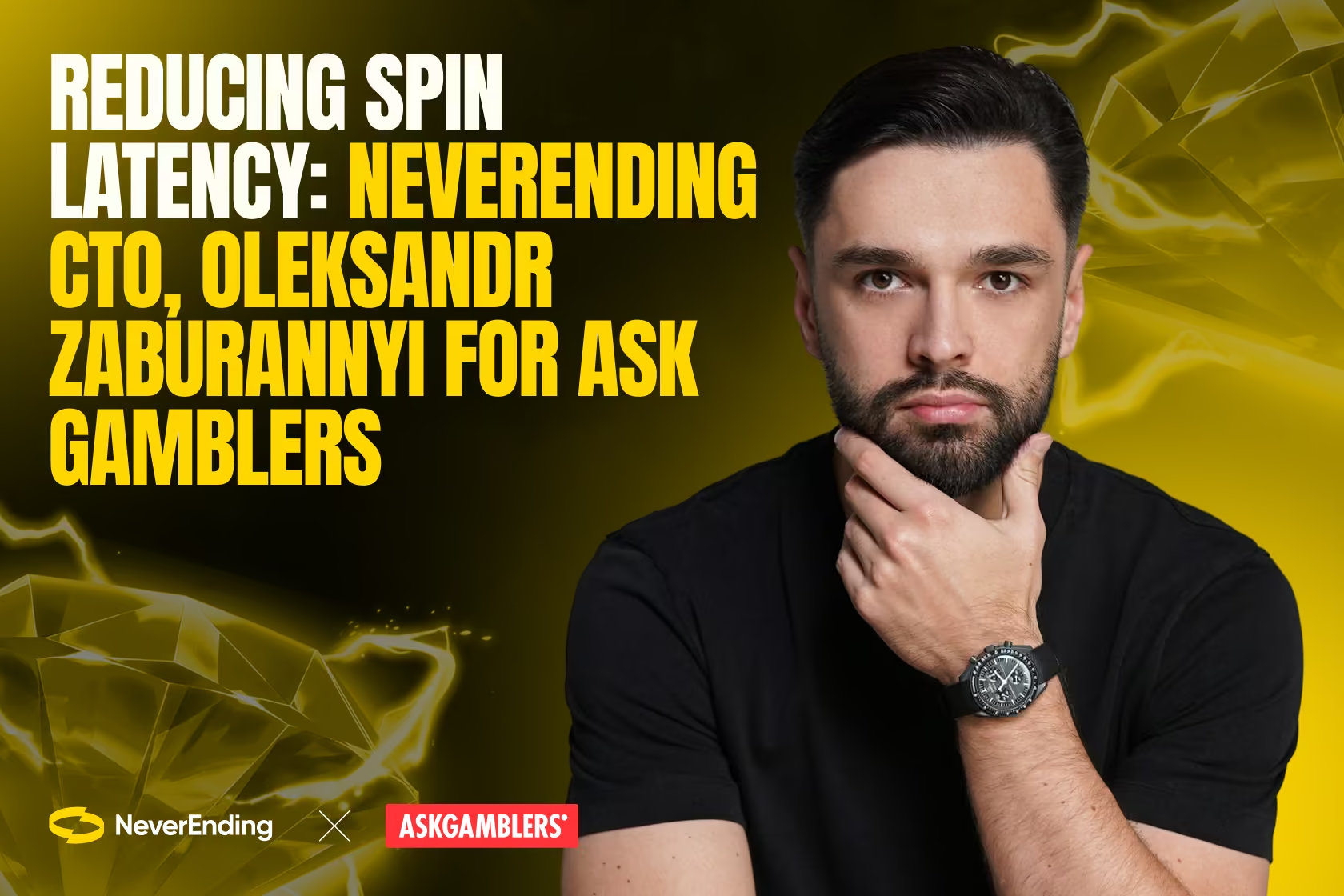
Oleksand Zaburannyi for G3 Media: NeverEnding is rewriting the rules

Original is published at G3 Media.
Legacy iGaming infrastructure is often a mix of outdated back-office systems, slow compliance workflows, and heavy aggregator layers.
From a CTO perspective, what are the biggest technical bottlenecks that still slow down integrations in 2026 — and how did you architect NeverEnding to eliminate them?
The actual problem is a gap between well-written technical documentation and how the system works in reality.
Integration engineers often spend significant time building integrations based on the provided technical documentation and covering every possible edge case with tests, only to discover that the system doesn’t behave as described due to inaccurate or outdated docs. As a result, they end up reworking or rewriting the integration entirely.
In practice, this often translates into two weeks of development, one week waiting for access to a test environment, and up to another week for fixes. Only after that can partner testing begin, which may take an undefined amount of time. If both sides operate in sprint cycles, the overall timeline extends even further.
NeverEnding positions itself around speed — 5-day integrations, same-day decisions, no red tape. What had to be true technically for that to work?
To achieve that we focus on 3 pillars:
MVP first: we focus on delivering a workable integration as quickly as possible so we can start setting up the test environment with the partner. Of course, we still cover the code with automated tests and conduct careful manual testing, but full validation comes after we confirm the “real” API behavior, helping us avoid unnecessary rework.
No sprints for the integration team: we use a Kanban approach to stay flexible and respond quickly to updates or clarifications that arise in technical discussions with partners. This allows us to adjust priorities in real time and keep integrations moving without waiting for the next sprint cycle.
Technical evolution: delivering an MVP quickly would be impossible without a system designed for speed and flexibility. We’ve built a platform that enables integrations with minimal code and effort, but we continue to refine it and are now testing AI-driven approaches to make the process even more efficient. I believe integrations should take hours, not days, and we’re actively working toward that goal.
Many Tier-1 providers move slowly not because they lack talent, but because their systems evolved over years of patches and acquisitions.
Did you build NeverEnding’s tech stack as a “clean-slate” architecture on purpose — and what advantages does that give you when entering new regulated markets?
Each regulation requires its own technical solution, and implementing changes within a legacy system can be extremely challenging. Drawing on our past experience, we’ve architected a platform that remains flexible and adaptable, allowing us to implement new regulatory requirements efficiently as we enter new regulated markets.
From your experience, what part of integration actually breaks most often in real life: game math certification, wallet synchronization, bonus logic conflicts, reporting mismatches, or human process delays? I would say wallet synchronization and bonus logic conflicts.
Where do operators usually underestimate complexity?
In some cases, operators may underestimate how critical performance is to the actual gameplay experience.
Let’s imagine that operators' wallets handle transaction requests for 1 sec and according to their API you have to send a separate bet and win for each spin.
Here is the math:
1 sec + 1 sec + our 200ms + some transport latency between all parts = more than 2.3 sec per spin.
That’s too slow for slot gameplay, even outside of turbo mode. In my experience, to run turbo mode smoothly and without glitches, total latency should stay below 500 ms. Reaching that level isn’t just about optimizing each side independently, it often requires rethinking the flow entirely, such as combining bet and win processing into a single request.
Promo tools are often treated as an afterthought — jackpots, tournaments, loyalty engines bolted on top of games.
Why did you decide to build engagement tools as a core part of your architecture rather than external modules?
All of these features have effectively become industry standards, making them essential rather than optional. Operators are constantly searching for ways to increase user engagement and retention, so we focus on providing a comprehensive set of tools that support those goals and help them stay competitive.
If you had to name one technical principle that defines NeverEnding’s “anti-bureaucracy” DNA — what is it?
Ownership is the key.
Is it decision velocity, ownership structure, modular architecture, deployment pipelines, or something less obvious?
We treat people as professionals and avoid micromanagement, giving them the autonomy to make decisions and take initiative. In return, we expect ownership, accountability, and measurable results.
.avif)